Click To Skip To Main Content



Hot Water System Replacement Cost Brisbane: 2026 Price Guide
If your hot water system is on its last legs, the first thing you want to know is what a replacement is going to set you back. Fair enough. The problem is most pricing guides online either give you a single number that means nothing for your place, or they dodge the question entirely and tell you to get a quote.
This guide is different. I'll walk you through what hot water system replacement actually costs in Brisbane in 2026, what moves the price up or down, and what you should expect to see on a proper quote. No fluff, no hidden sales pitch.
Hot water system replacement cost in Brisbane in 2026 typically falls between $1,200 and $6,000 fully installed, depending on the type of system you're putting in and how straightforward the install is. Most Brisbane homeowners spend somewhere between $2,000 and $3,500 for a like-for-like swap. Heat pumps and solar sit at the top end. Electric storage sits at the bottom.
Now let's break down why the range is that wide, and what determines where your job lands on it.
Table of contents
- Hot water replacement cost at a glance
- What you're actually paying for
- Cost by hot water system type
- 9 factors that move your quote up or down
- Rebates in Queensland in 2026
- Running costs over 10 years
- A local Brisbane tip: check your sacrificial anode
- When repair beats replacement
- What to look for on a quote
- FAQs
Hot water replacement cost at a glance
Here's the quick version for anyone who just wants the numbers. These are typical fully installed ranges across the Brisbane market in 2026, based on standard like-for-like replacements in a reasonably accessible spot.
| System type | Typical installed cost | After rebates |
|---|---|---|
| Electric storage | $1,000 – $2,800 | Not eligible |
| Gas storage | $1,800 – $3,200 | Not eligible |
| Gas continuous flow (instant) | $2,000 – $3,500 | Not eligible |
| Heat pump | $3,500 – $6,000 | $2,800 – $5,000 |
| Solar hot water | $4,000 – $8,500 | $3,200 – $7,500 |
These numbers assume a straightforward swap. If you're switching fuel sources, moving the unit's location, or dealing with access issues, you'll land higher. I'll get into all of that further down.
If you already know which system you want and need a ballpark for a repair instead, check the repair vs replacement section further down. Sometimes a replacement part is all you need.
What you're actually paying for
A hot water system replacement isn't just the unit. The sticker price on a Rheem or a Rinnai you see online is about half the story. The total bill covers four things:
- The unit itself. Brand, fuel type, size, and efficiency all move this number. A basic electric storage tank is cheap. A premium heat pump or CO2 split system is not.
- Labour. A licensed plumber's time to disconnect the old unit, fit the new one, pressure test, and commission. For gas jobs, a gas fitter's labour on top. Most swaps take 2 to 4 hours once we're on site, but tricky ones stretch out.
- Parts and compliance gear. Tempering valves, pressure-limiting valves, expansion control valves, isolation valves, pipework, brackets, and flue components. These add up fast on an older property that's missing current compliance fittings.
- Disposal of the old unit. A proper plumber takes the old tank with them. Council won't collect a 300-litre tank on kerbside pickup.
On a straightforward job, the unit is usually 40 to 60 percent of the total. Labour and materials make up the rest. On a tricky job, labour and compliance upgrades can flip that ratio entirely.
Cost by hot water system type
Different systems hit different price points for different reasons. Here's where each sits in the Brisbane market in 2026, and who it tends to suit.
Electric storage
Typical installed range: $1,000 to $2,800
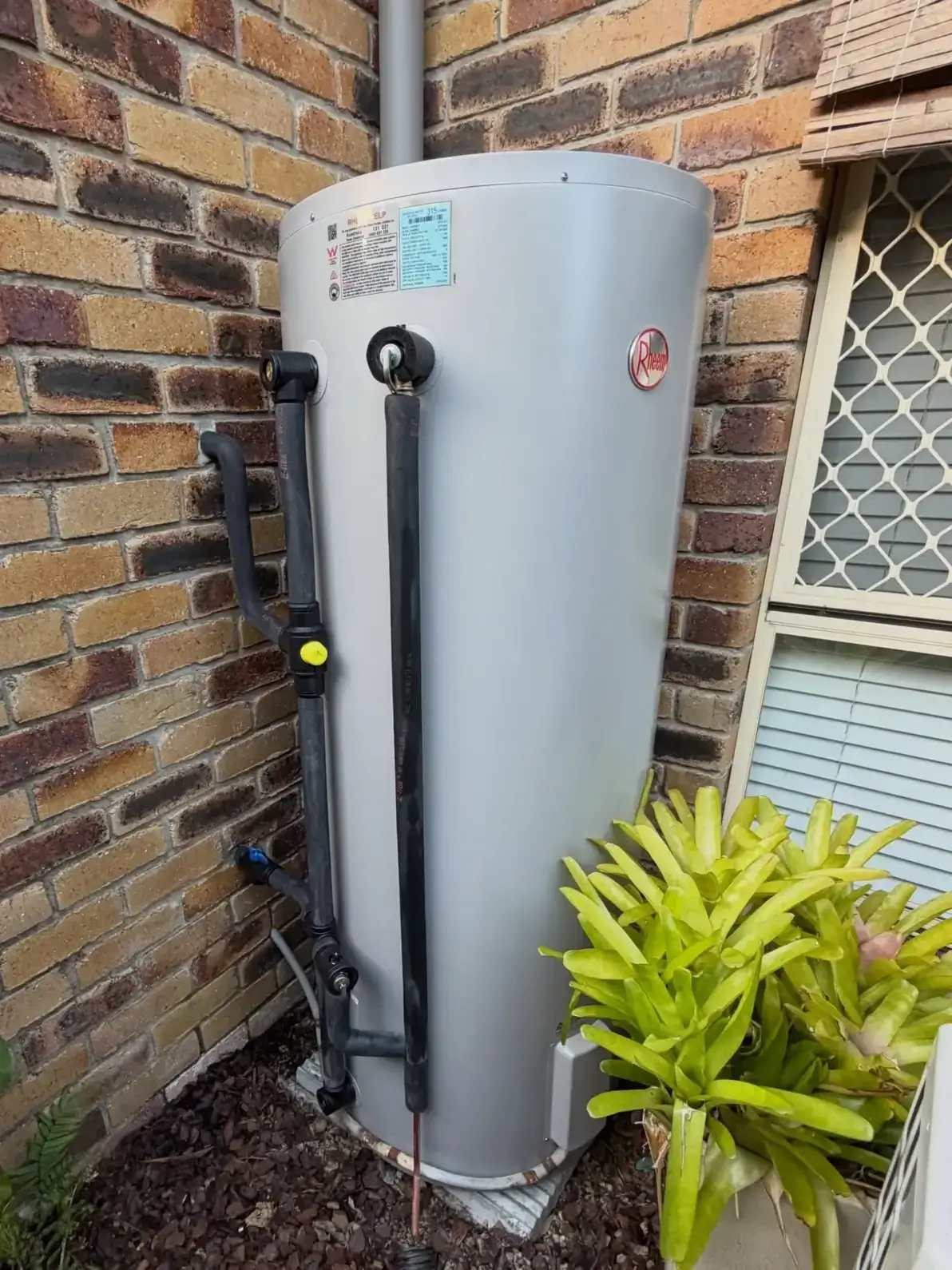
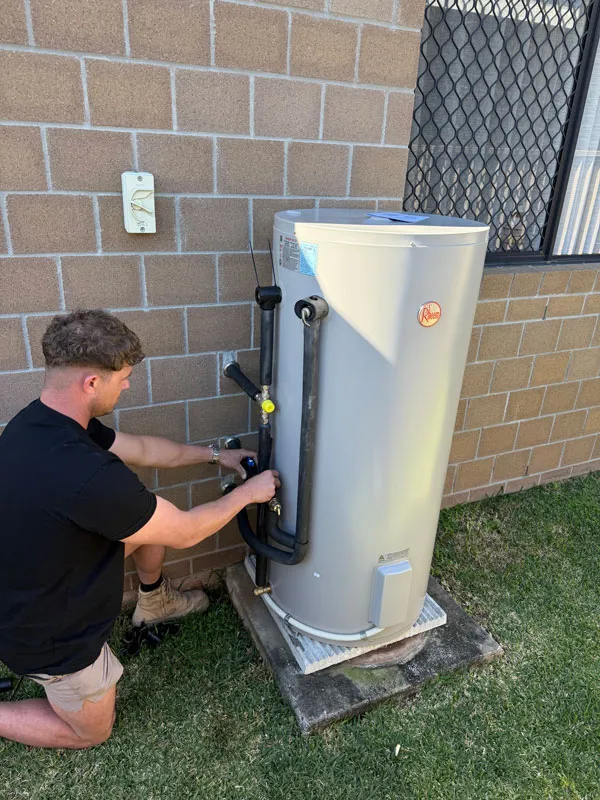
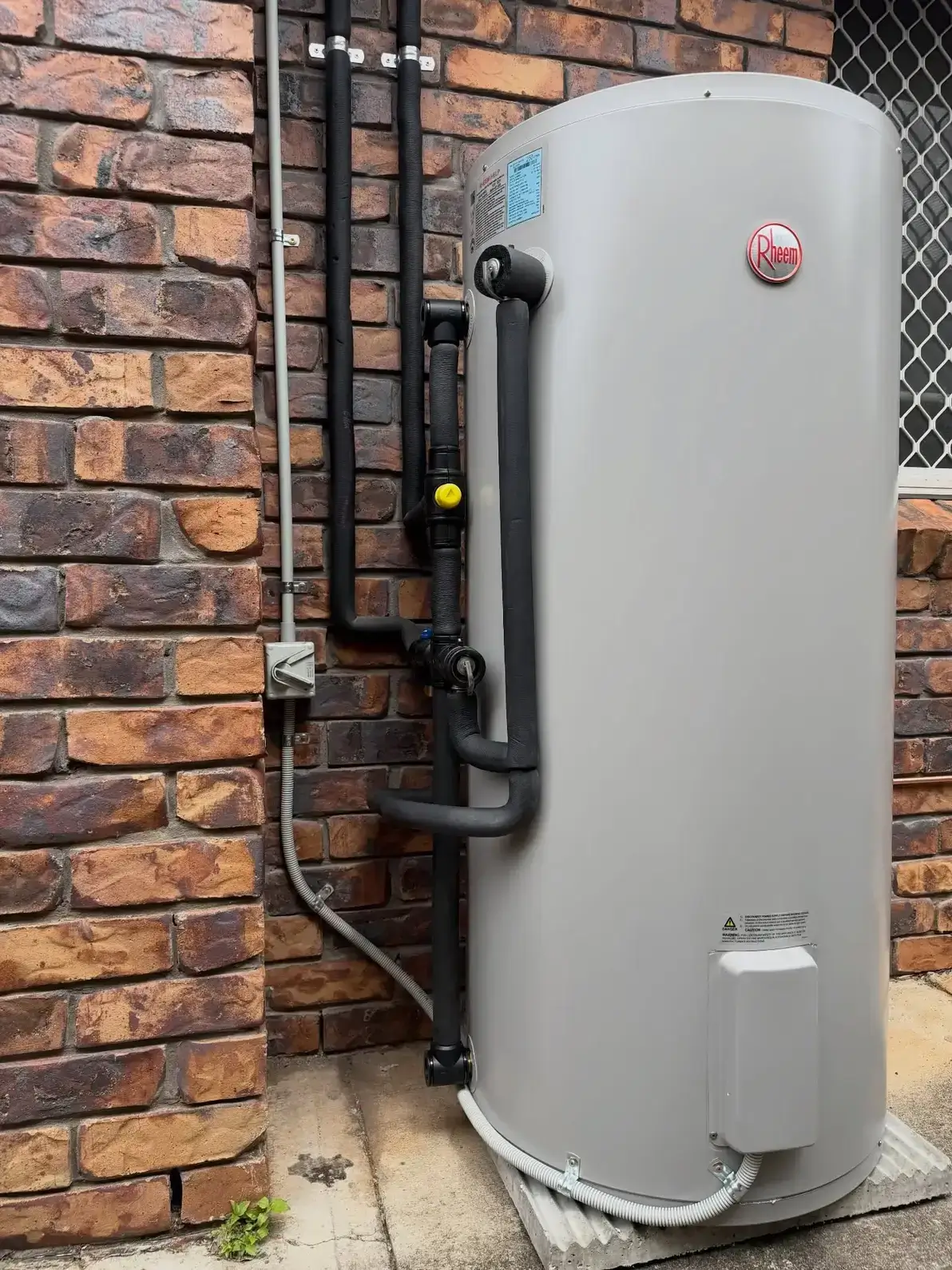
The cheapest option upfront and still the most common in older Brisbane homes. You're looking at a tank (usually 160L to 315L) with an electric element that heats the water overnight on a controlled tariff, or continuously on a standard tariff.
The units themselves are cheap because the tech is simple. A 250L Rheem or Dux runs $700 to $1,200 at the supplier. Installation labour for a straight swap sits around $400 to $700. That gets you into the $1,100 to $1,900 zone for a basic replacement, climbing higher if valves need replacing or the tank stand is rusted through.
Electric storage is often the right pick if you're on a tight budget, renting out the property, or the old system is already electric and access is easy. It's also the only option that doesn't qualify for any rebates.
Have a read of our electric hot water system installation page for more detail on sizing and brands.
Gas storage
Typical installed range: $1,800 to $3,200
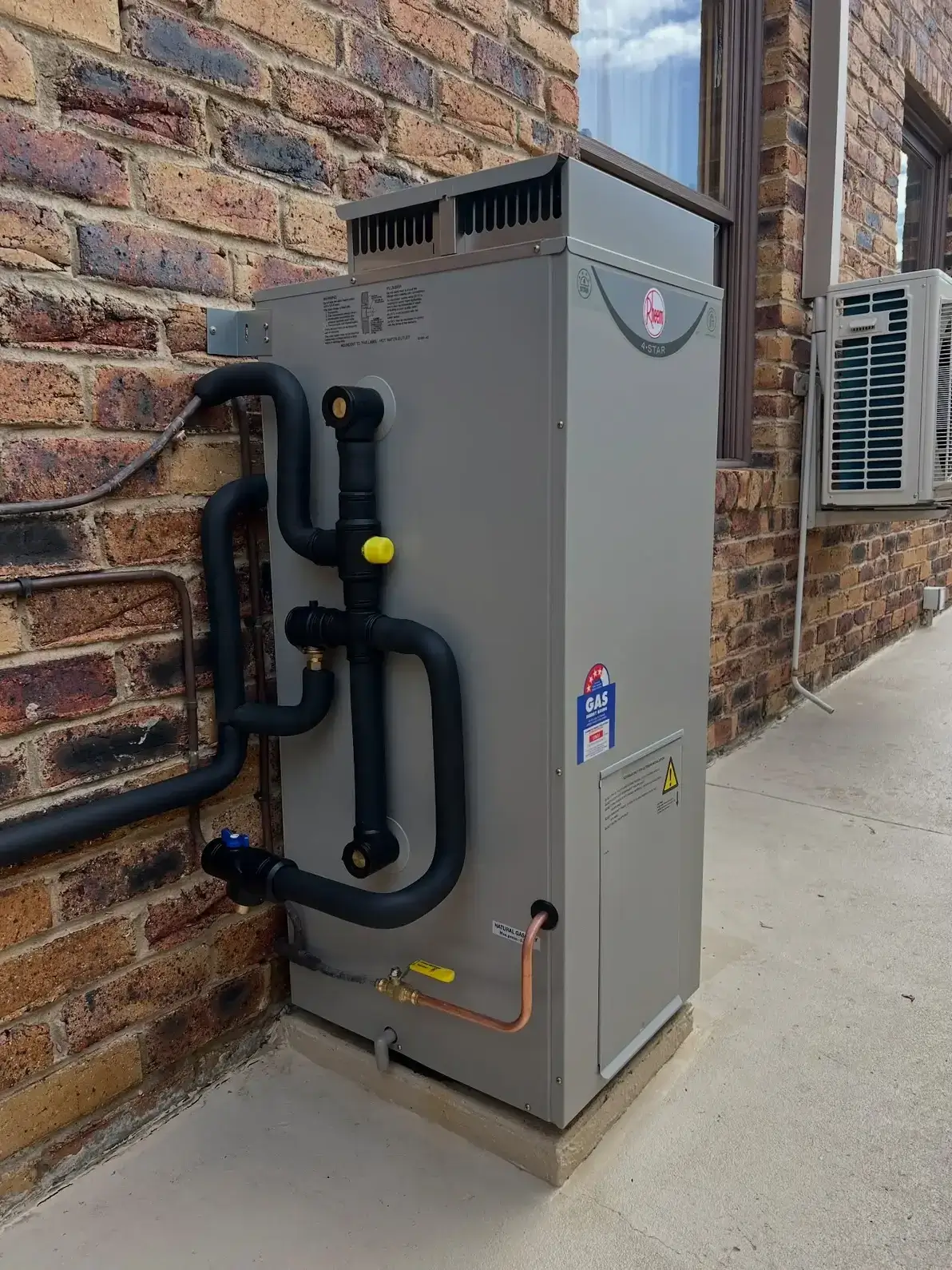
Gas storage tanks work the same way as electric ones, except a gas burner does the heating instead of an element. You need a mains gas connection or LPG bottle setup. Brisbane homes in the inner suburbs usually have mains gas available. Northside suburbs further out and most of Moreton Bay are a mix of mains gas, LPG, or no gas at all.
The units cost more than electric (roughly $1,100 to $1,800 at the supplier), and the install is more involved because a licensed gas fitter has to handle the gas connection, pressure test, and flue work. That pushes the total to $1,800 to $3,200 for a like-for-like swap.
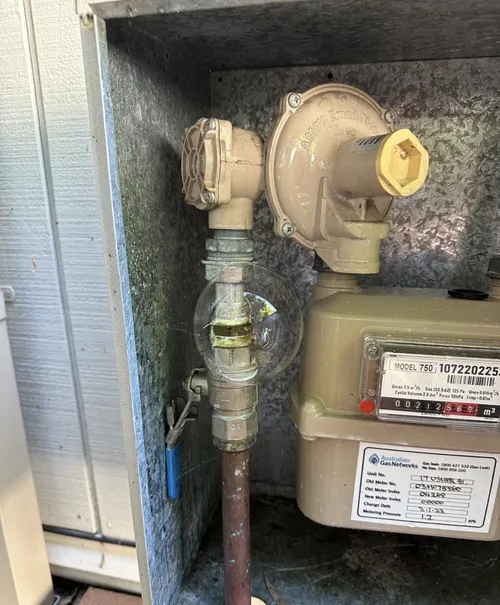
If you're switching from electric to gas, the cost can climb quickly because you need new gas pipework run to the unit. I'd usually budget another $800 to $1,500 on top for that.
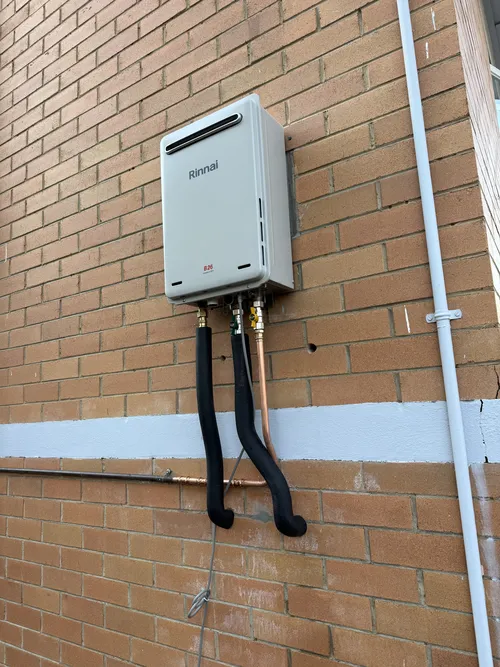
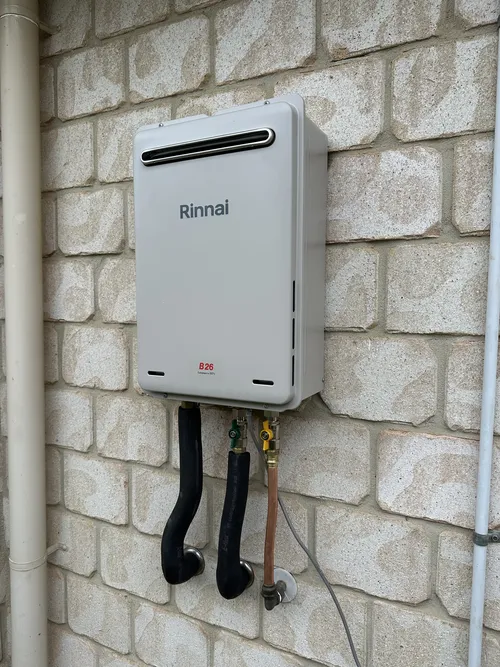
Gas continuous flow (instant)
Typical installed range: $2,000 to $3,500
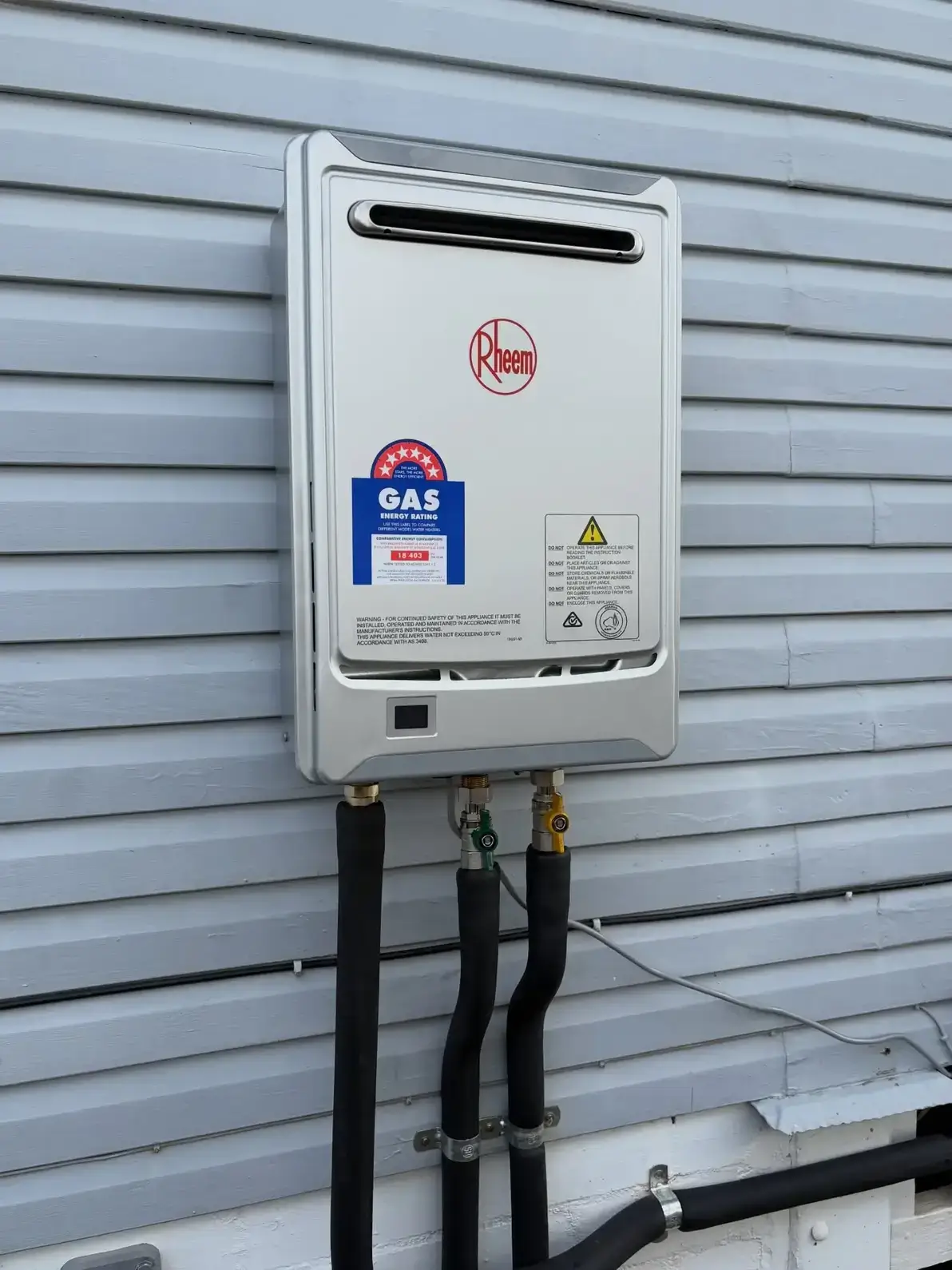
Also known as instant or tankless gas. No tank, the unit heats water on demand as it passes through. Popular with newer builds and families who burn through a lot of hot water.
Units run $900 to $2,000 at the supplier depending on flow rate and star rating. Install is comparable to gas storage but slightly simpler because there's no tank to mount, just a wall-hung unit. Total installed usually lands at $2,000 to $3,500 for a like-for-like swap.
If you're moving from a storage tank (gas or electric) to a continuous flow, expect the upper end of that range or higher. The gas line often needs upsizing to handle the higher flow rates these units demand. I've covered the fuel comparison in detail in my post on gas vs electric hot water systems.
See our gas hot water system installation or instant gas hot water installation pages for more.
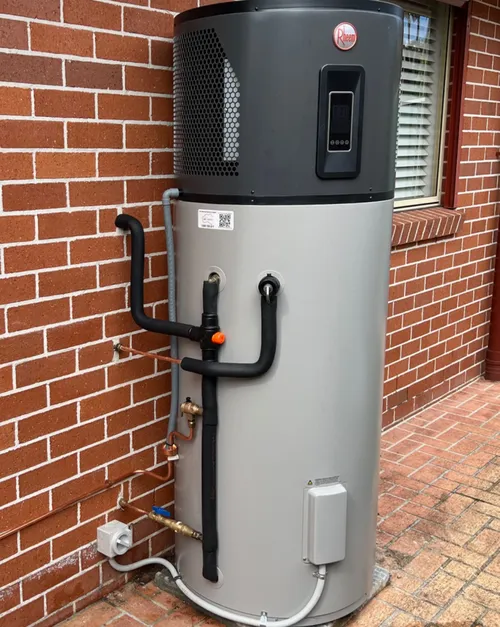
Heat pump
Typical installed range: $3,500 to $6,000 before rebates
Heat pumps are the big growth area in 2026. They work like a reverse air conditioner, pulling heat from the surrounding air to warm the water in the tank. In Brisbane's climate they run very efficiently, which is why federal rebates and state programs have been pushing them hard.
Unit prices vary widely. An entry-level integrated unit (compressor sitting on top of the tank) starts around $2,500 at the supplier. A premium CO2 split system like a Sanden or Reclaim Energy can hit $4,500 to $5,500 just for the unit. Labour is higher than a standard swap because heat pumps need proper clearance for airflow, a condensate drain, and sometimes a concrete slab or bracket system.
After federal STC rebates, most Brisbane homeowners are paying $2,800 to $5,000 net for a heat pump replacement. More on rebates below.
Full breakdown on our heat pump hot water installation page.
Solar hot water
Typical installed range: $4,000 to $8,500 before rebates
Roof-mounted collector panels or evacuated tubes, with a storage tank either on the roof (close-coupled) or on the ground (split system). Electric or gas boosters kick in when the sun doesn't cooperate.
Solar is the most expensive option upfront because you're paying for the panels, the tank, the mounting system, and the plumbing to tie it all together. Installation takes longer too, often a full day's work with a roof plumber and a general plumber on site.
After federal STC rebates, expect to pay $3,200 to $7,500 net. Brisbane's sun makes solar a legitimate long-term play if you're staying in the house for 10+ years and your roof faces the right way.
More on our solar hot water installation page.
9 factors that move your quote up or down
This is the part most price guides skip, and it's the part that actually matters. Two Brisbane homes can get quotes $1,500 apart for the same model unit, and both quotes are fair. Here's what's going on.
1. Access to the existing unit
A hot water system tucked neatly beside an external wall with a clear path is a dream job. A unit wedged under a Queenslander between the stumps, or on a second-storey balcony with no stairs access, is not. Tight access means longer labour time and sometimes two plumbers instead of one.
I've done jobs in Wilston and Grange where we had to carry a 300L tank through the house because the side access was too narrow. That's an extra hour easily, and floor protection, and risk of damage. All of that flows into the quote.
2. Switching fuel types
Going electric to electric, or gas to gas? Simple. Going from electric to gas, gas to heat pump, or anything that changes the fuel source? That's a different job.
- Electric to gas: need gas line run to the unit, gas meter check, new flue. Add $800 to $2,000.
- Gas to electric or heat pump: need new electrical circuit, possibly a dedicated switchboard upgrade. Add $400 to $1,500.
- Storage to continuous flow: may need gas line upsizing and a new flue termination. Add $300 to $900.
If you're curious whether a fuel switch makes sense financially, the running cost section below will help.
3. Tempering valve compliance
Current standards under AS/NZS 3500.4 require a tempering valve on new installs that limits bathroom hot water to 50°C to prevent scalding. Heaps of older Brisbane homes don't have one fitted. If yours doesn't, it's getting added with your new system.
A tempering valve kit and install runs $150 to $300. Non-negotiable on a new install. Any plumber telling you they can skip it to save you money is setting you up for a failed inspection.
4. Pressure limiting and expansion control valves
Brisbane's mains water pressure in a lot of the Northside sits above 500 kPa. New hot water systems are typically rated for 500 kPa inlet pressure, so a pressure limiting valve is often needed. Expansion control valves are also required on mains-pressure storage systems to prevent the tank from over-pressurising as water heats and expands.
Together, these add $200 to $450 to the job if they're missing or aged beyond spec.
5. Old asbestos flues
Gas hot water systems installed before the mid-1980s sometimes have asbestos cement flues. If yours does, it can't just be ripped out. It needs licensed asbestos removal, which adds $400 to $1,000 to the job and a day of paperwork.
I still come across these in older Alderley, Wilston, and Clayfield homes. It's not fun to find on the day, which is why a proper pre-install inspection matters.
6. Stand, bracket, or slab work
Ground-mounted tanks sit on either a concrete slab or a metal stand. Rusted stands need replacing. A missing or cracked slab needs pouring. Heat pumps often need a new slab for the compressor unit to sit on.
Slab or stand work adds $200 to $800 depending on what's needed. Wall-mounted systems (continuous flow, some heat pumps) can need bracket upgrades if the existing wall framing isn't up to it.
7. Electrical upgrades
Heat pumps, electric storage tanks, and continuous flow units with electric ignition all need working electrical connections. If your existing circuit is old, undersized, or non-compliant, an electrician needs to come in.
A standard outlet swap is cheap. A full circuit upgrade from the switchboard is $400 to $900. If the switchboard itself needs work (happens in older homes with fuse boxes), budget more.
8. Compliance paperwork and certificates
Every gas hot water install requires a gas compliance certificate. Plumbing work requires a Form 4 or similar under the Plumbing and Drainage Act 2018 depending on the job. These aren't line items most people notice, but they take time and they're legally required.
Any plumber who isn't lodging these with the QBCC is cutting corners. The QBCC has a straightforward tool for checking a plumber's licence before you book them.
9. Removal and disposal
Old tanks aren't free to get rid of. Between the metal recycling and the time to load, haul, and dispose of it, most plumbers build $50 to $150 into the quote for disposal. Some try to leave it behind to save money. Don't let them, it's your problem if it stays.
Rebates in Queensland in 2026
Rebates genuinely move the needle on heat pump and solar pricing. But there's a lot of outdated info floating around online, so here's the honest 2026 picture for Brisbane homeowners.
Federal STCs (still active)
Small-scale Technology Certificates are the main rebate available in Queensland in 2026. They're part of the federal Small-scale Renewable Energy Scheme run by the Clean Energy Regulator. You don't apply for them directly in most cases, your installer claims them and discounts your quote upfront.
How it works:
- Each eligible heat pump or solar hot water system earns a set number of STCs based on the unit's efficiency and your climate zone. Brisbane sits in Zone 3.
- Each STC has a market-based cash value, typically $33 to $40 in 2026.
- A typical Brisbane heat pump install earns 14 to 28 STCs, which translates to roughly $500 to $1,100 off the installed price.
- Premium high-COP heat pumps (like Sanden or Reclaim Energy CO2 units) earn more STCs, often pushing the discount to $900 to $1,100.
STCs are phasing down each year and are expected to disappear around 2030. If you're going to upgrade to a heat pump, doing it sooner rather than later means a bigger rebate. Full scheme detail is on the Clean Energy Regulator's website.
Queensland state rebates (currently closed)
The Queensland Government ran a popular program called Climate Smart Energy Savers that gave $800 to $1,000 off eligible hot water heat pump replacements. It was heavily oversubscribed and closed in 2024.
As of April 2026, there's no active Queensland state rebate specifically for residential hot water replacements. I'd keep an eye on the Queensland Government's rebates and concessions page in case a new program launches, but for now federal STCs are the only rebate a Brisbane homeowner can stack.
What doesn't qualify
A few things people commonly misunderstand:
- Electric storage tanks get no rebate, no matter the brand.
- Gas hot water (storage or continuous) gets no rebate in Queensland.
- Like-for-like replacements of existing heat pumps or solar may not qualify if the old unit hasn't been in for long enough.
If your installer is claiming a rebate that sounds too good to be true, ask them to name the scheme and show you the STC certificate number on the final invoice.
Running costs over 10 years
Upfront price is only half the story. The cheapest system to install is often the most expensive to run, and vice versa. Here's the rough 10-year picture for a typical Brisbane family of four using around 200L of hot water a day.
| System type | Annual running cost | 10-year running cost |
|---|---|---|
| Electric storage (standard tariff) | $700 – $900 | $7,000 – $9,000 |
| Electric storage (controlled tariff) | $450 – $650 | $4,500 – $6,500 |
| Gas storage | $350 – $550 | $3,500 – $5,500 |
| Gas continuous flow | $300 – $500 | $3,000 – $5,000 |
| Heat pump | $150 – $300 | $1,500 – $3,000 |
| Solar hot water (with electric boost) | $100 – $250 | $1,000 – $2,500 |
Look at those numbers. A standard-tariff electric storage tank can chew through $8,000 over a decade, while a heat pump might run you $2,000 over the same period. Even after accounting for the higher upfront cost of the heat pump, you're thousands ahead by year 7 or 8.
That's why I steer most of my customers toward heat pumps these days, especially if they're staying in the house long term. The maths just works, and Brisbane's climate makes heat pumps perform at the top end of their efficiency range. If you want to dig deeper into the energy comparison, Energex's energy efficiency guide covers how different systems stack up on different tariffs.
A local Brisbane tip: check your sacrificial anode
Here's one bit of maintenance advice most Brisbane homeowners never hear: storage tank hot water systems have a sacrificial anode rod inside them. Its job is to corrode slowly so your tank doesn't. Once the anode is fully eaten away, rust starts attacking the tank itself, and that's when you get a leak from the bottom of the unit and a dead system.
In parts of the Northside and across most of Moreton Bay (supplied by Unitywater), water hardness and mineral content can chew through an anode rod faster than average. I've pulled anode rods out of 6-year-old tanks in places like Narangba and North Lakes that were already almost gone. On the other hand, I've seen Brisbane City (Urban Utilities) tanks with plenty of anode left at the 8-year mark.
Getting a licensed plumber to check and replace the anode every 5 years costs a fraction of a new hot water system and can add 3 to 5 years to your tank's life. It's a 15-minute job that's easy to bundle with a regular service. If you're in a harder-water area, this is the single best thing you can do to get full life out of a storage system.
Not relevant for continuous flow, heat pumps, or solar systems, since they either don't have a tank or use different corrosion protection.
When repair beats replacement
Before you drop thousands on a new unit, it's worth knowing when a repair is the smarter call. Not every failing hot water system needs replacing.
Consider a repair if:
- The unit is under 7 years old and it's a specific component that's failed (element, thermostat, valve, thermocouple).
- The tank itself is sound with no leaks.
- The brand is still supported with parts available.
- Repair cost is less than 40 percent of replacement cost.
Go straight to replacement if:
- The tank is leaking from the bottom or sides. Tank failure is terminal.
- The unit is 10+ years old. Even if you fix one thing, something else will fail soon.
- Parts are discontinued or back-ordered.
- The unit fails the energy efficiency check or is non-compliant with current standards.
I've written a full breakdown of the decision logic in my hot water repair vs replacement guide. Worth a read if you're on the fence.
What to look for on a quote
A proper hot water replacement quote should spell out every cost line by line. If you're getting a single number with no breakdown, ask for detail. Here's what a clean quote looks like.
A proper quote includes:
- Unit make, model, capacity, and star rating. Not just "new hot water system." The exact model.
- Labour line item. Disconnect, install, commission. Usually a flat fee.
- Compliance fittings. Tempering valve, pressure limiting valve, expansion control valve, isolation valves. Listed individually or as a "compliance kit."
- Flue or vent work. Relevant for gas systems.
- Electrical work if needed. Separate line if an electrician is involved.
- Rebate deduction. Clearly shown as STCs off, not buried.
- Removal and disposal. Of the old unit.
- Warranty terms. Unit warranty (5 to 10 years typical for tanks, longer for heat pumps) and workmanship warranty (usually 12 months minimum).
- QBCC licence number. On the quote and the invoice.
Red flags to watch for:
- "Supply and install" with no breakdown. You don't know where the money's going.
- Huge discount if you sign today. Legit pricing doesn't need pressure tactics.
- No tempering valve mentioned. It's required on new installs.
- No disposal included. You'll either pay extra or be stuck with a tank in your yard.
- Plumber won't show their QBCC licence. Walk away.
Getting three quotes for a hot water replacement is normal and smart. Just make sure you're comparing apples to apples on the model and the inclusions, not just the bottom-line number.
When you're ready to replace your hot water
Replacing a hot water system in Brisbane in 2026 costs between $1,200 and $6,000 for most setups, with the final number driven by system type, access, fuel switch, compliance upgrades, and rebates. There's no honest one-size-fits-all number, but the ranges above should give you a solid frame of reference before you start getting quotes.
A few things worth remembering:
- Upfront cost isn't the whole story. A cheap electric tank can cost you thousands more than a heat pump over 10 years.
- STC rebates are real and worth claiming if you're going heat pump or solar. Make sure they're itemised on your quote.
- Compliance fittings aren't optional. Tempering valves, pressure limiting valves, and expansion control valves are all required under current standards.
- Access and fuel switching are the two biggest wildcards that move a quote up or down by more than $1,000.
If you're in Brisbane Northside or Moreton Bay and your system is on the way out, get in touch through our contact page or check out our main hot water systems service page for more detail on the systems we fit. We cover the full Brisbane Northside and Moreton Bay regions, and if your current system has already failed, our emergency plumbing service is the fastest way to get hot water back on.
FAQs
How much does a hot water system cost to replace in Brisbane in 2026?
A typical hot water system replacement in Brisbane in 2026 costs between $1,200 and $6,000 fully installed, depending on the system type. Electric storage sits at the low end ($1,000 to $2,800), while heat pumps ($3,500 to $6,000) and solar ($4,000 to $8,500) are the most expensive upfront. Most homeowners spend $2,000 to $3,500 on a like-for-like swap.
Can I claim a rebate on a new hot water system in Queensland?
Yes, if you're installing an eligible heat pump or solar hot water system, you can claim federal Small-scale Technology Certificates (STCs), typically worth $500 to $1,100 off the installed price in Brisbane. The Queensland Climate Smart Energy Savers rebate closed in 2024, so STCs are the only rebate available for residential hot water in 2026. Electric and gas storage systems don't qualify.
How long does a hot water system replacement take?
A straightforward like-for-like replacement usually takes 2 to 4 hours from when the plumber arrives to when the new system is commissioned and running. More complex jobs (fuel switching, solar installs, heat pumps needing a slab) can take a full day. Your plumber should give you a time estimate when they quote.
Do I need a tempering valve on a new hot water system?
Yes. Under AS/NZS 3500.4, all new hot water installations in Queensland require a tempering valve that limits bathroom hot water to 50°C. This is a scald-prevention requirement. A tempering valve adds $150 to $300 to the job if your existing setup doesn't already have one. Any plumber who skips this is setting you up for a failed inspection.
Is a heat pump worth it in Brisbane?
For most Brisbane homes, yes. Heat pumps run at peak efficiency in warm climates and Brisbane sits firmly in that sweet spot. Annual running costs are $150 to $300 compared to $700+ for standard electric storage. Combined with federal STC rebates of $500 to $1,100, most homeowners break even within 4 to 7 years and save thousands over the system's lifetime.
Can I replace a hot water system myself?
No. Under the Queensland Plumbing and Drainage Act 2018, all hot water system work must be done by a licensed plumber. Gas hot water additionally requires a licensed gas fitter. DIY installation voids the manufacturer's warranty, isn't covered by home insurance, and can result in QBCC penalties. It's also genuinely dangerous, especially with gas.
What size hot water system do I need for my home?
A rough guide by household size:
- 1 to 2 people: 125L to 160L storage, or small continuous flow
- 3 to 4 people: 250L to 315L storage, or medium continuous flow
- 5+ people: 315L to 400L storage, or large continuous flow
Heat pumps typically come in 200L to 315L sizes. Your actual usage patterns matter too. Families with teenagers who shower twice a day need bigger capacity than a couple who shower once.
How long should a hot water system last in Brisbane?
Electric storage tanks typically last 8 to 12 years in Brisbane, though water hardness in parts of the Northside and across Moreton Bay (supplied by Unitywater) can shorten that. Having your sacrificial anode rod checked every 5 years is the single best thing you can do to extend tank life. Gas storage lasts 10 to 15 years. Continuous flow units and heat pumps generally run 12 to 20 years with proper servicing. Solar systems have the longest lifespans, often 15 to 20+ years for the collectors and 8 to 12 for the booster/tank component.